




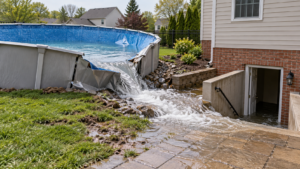
Above-Ground Pool Collapsed? Understanding Your Water Damage Insurance Claim
An above-ground pool can release thousands of gallons of water in seconds when a wall gives way. If that water reaches your home, the damage can spread through finished rooms, flooring, insulation, and personal belongings.
For homeowners in Pennsylvania and New Jersey, the next challenge may be understanding the insurance company’s response. A carrier may describe the loss as “groundwater,” “surface water,” or “flood damage.” Those terms can affect coverage, but determining which provision applies requires a careful review of the policy and the facts.
Community Public Adjusters helps homeowners document property damage and understand the issues affecting their insurance claims.
Does Homeowners Insurance Cover Water From a Collapsed Pool?
There is no single answer that applies to every policy. Coverage can depend on:
- What caused the pool to fail.
- How the released water traveled to the house.
- Where the water entered the building.
- The policy’s coverage provisions, exclusions, and endorsements.
- Whether the claim involves damage to the pool, the house, personal belongings, or several types of property.
Damage to the pool itself and resulting damage to your home may involve different policy provisions. Each part of the loss deserves its own review.
Why the Water’s Path Matters
Consider two possible situations.
In one, a pool wall suddenly fails and water rushes across a patio and through a basement doorway. In another, released water saturates the soil and later seeps through the foundation.
Those circumstances may raise different coverage questions. Documenting the actual route of entry helps establish what happened and allows the policy language to be evaluated against the evidence.
The fact that water came from a swimming pool does not automatically establish coverage. Likewise, a denial should be examined to determine whether the exclusion cited by the insurer fits the documented circumstances.
What to Do After a Pool Collapse
Put Safety First
Keep people and pets away from unstable pool walls and damaged equipment. Avoid standing water near electrical outlets, pumps, appliances, or wiring. Have qualified professionals address electrical and structural hazards before entering unsafe areas.
Photograph the Pool and the Water’s Route
When it is safe, photograph or record:
- The failed pool wall, liner, supports, and equipment.
- Debris and visible water marks.
- The route between the pool and the house.
- Doors, windows, foundation openings, and other possible entry points.
- Damage inside the home.
Wide photographs show the overall scene, while close photographs capture individual conditions. Both can help explain the loss.
Report the Loss Promptly
Provide the insurance company with an accurate description of what you observed. Distinguish between what you witnessed and what you discovered afterward. Avoid guessing about the cause of the collapse or the water’s underground movement.
Take Reasonable Steps to Limit Further Damage
Arrange appropriate emergency services when needed. Keep invoices, receipts, photographs, and records of the work performed. Document damaged materials before removal and coordinate inspection opportunities when practical, without delaying necessary safety measures.
What if the Insurance Company Denies the Claim?
Request the denial in writing, including the specific policy provisions and the factual basis for the decision.
A claim review should compare the carrier’s explanation with the complete policy, photographs, inspection findings, and available evidence about the pool failure and water entry.
Questions worth examining include:
- Did the insurer correctly identify where the water entered?
- Does the investigation support the stated cause of damage?
- Were all applicable endorsements considered?
- Were damage to the pool and damage to the home evaluated separately?
- Does the estimate include the full documented scope of damage?
A disagreement does not guarantee that a denial will be reversed. It does mean the facts and policy language should be reviewed carefully before the homeowner decides how to proceed.
How Community Public Adjusters Can Help
A sudden property loss can leave homeowners dealing with cleanup, repairs, estimates, and unfamiliar insurance language at the same time.
Community Public Adjusters assists with documenting damage, preparing estimates, reviewing the carrier’s assessment, and presenting the homeowner’s claim. When a dispute requires legal advice or litigation, an attorney can evaluate those issues.
Has a pool collapse caused water damage to your home? Contact Community Public Adjusters to discuss your claim and the documentation needed to evaluate the loss.
We represent home and business owners and have vast experience with the following types of claims:
- Fire and smoke damage claims
- Water damage claims
- Flood damage claims
- Theft and vandalism damage claims
- Snow and ice damage claims
- Building collapse claims
- Wind and hail damage claims
- Catastrophic damage claims
- Roof leaks
- Blown off shingles & siding
- All plumbing leaks
- Toilet overflow
- Burst Pipes
- Frozen Pipes